

That "Mortgage Protection" Letter Isn't From Your Lender. Here's the Conversation You Should Have Instead.

October 12, 2026

If you just closed on a home, keep an eye on your mailbox. Within a few weeks, an official looking letter is probably going to show up with your name, your lender's name, your loan amount, and sometimes your closing date printed right on it. It looks like it came from your mortgage company.


It didn't. It didn't come from me, it didn't come from Nexa, and it didn't come from the company that will be servicing your loan. It's marketing, and responding to it is not required.


Where These Letters Come From

In Louisiana, when your loan closes, the mortgage gets recorded with the clerk of court in your parish. Once it's recorded, it's public record. That's how it should work, because those records protect your ownership and make it possible to buy and sell property safely. It also means anyone can pull your name, address, lender and loan amount.


My friend Marcel Lashover, a licensed life insurance professional in Metairie, explained how the business works after his own refinance closed. Mail houses pull the new recordings from the clerk of court, then send pieces built to look like they came from your mortgage company. People assume it's from their lender, so they fill out the card and send it back. That reply card is the product. Your information gets sold or shared, and suddenly several insurance agents are calling and emailing you, all racing to be the first one to close the sale.


What the Mailers Look Like

This is the actual stack Marcel received after his own closing: 13 separate pieces from different companies. We blacked out his name, address, loan amount, lender and every account number, barcode and QR code.


Thirteen mortgage protection insurance mailers received after one Louisiana loan closing, personal details blacked out

Thirteen mailers, one closing. Every one of these arrived after a single loan was recorded.
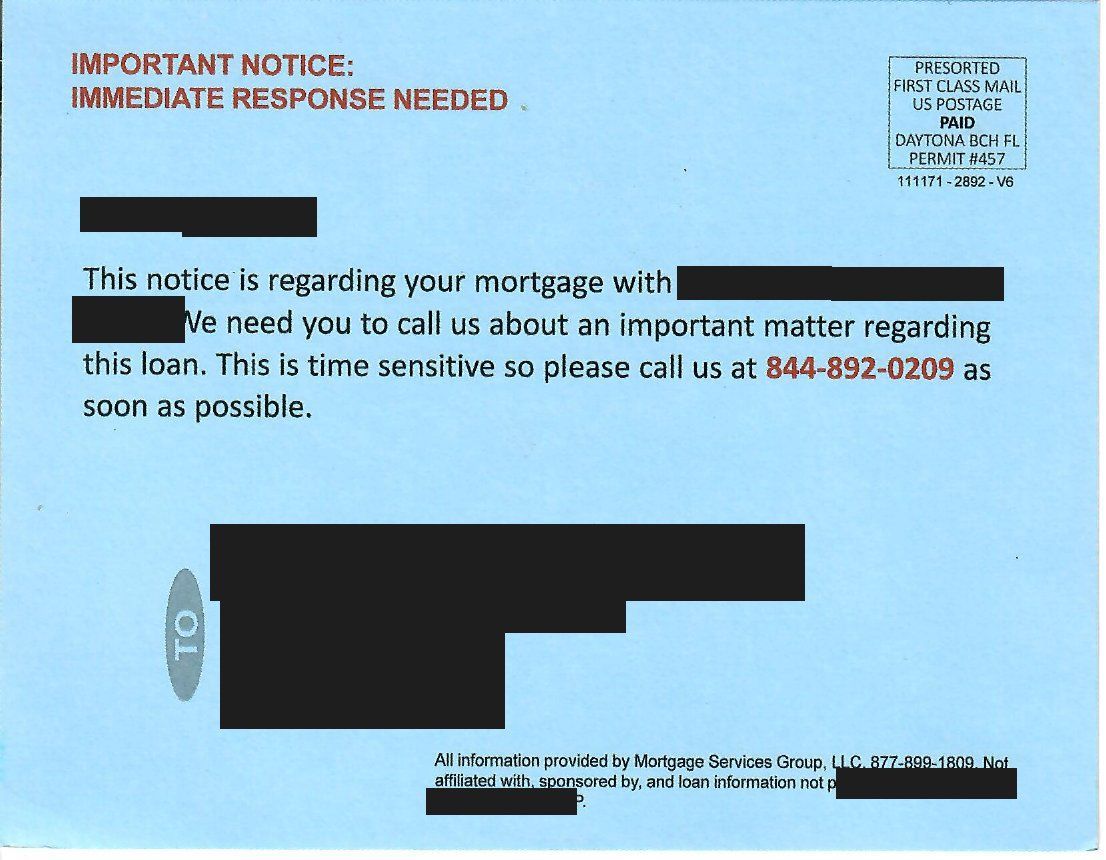

Blue mortgage protection postcard marked Important Notice, Immediate Response Needed]

A real mailer received weeks after closing. "Immediate response needed," with the lender's name in bold.
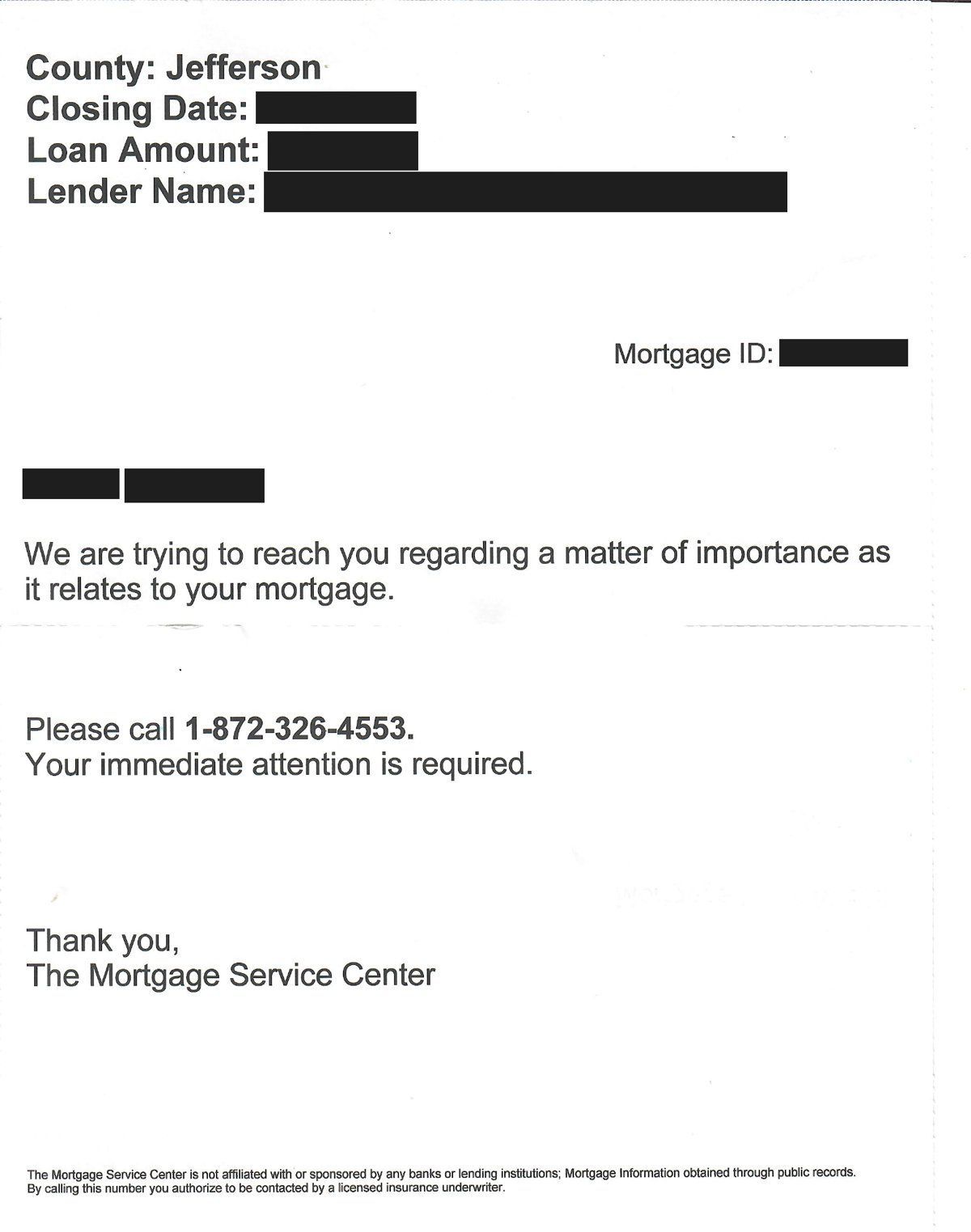
Mortgage Service Center letter listing county, closing date, loan amount and lender pulled from public recordg]

Closing date, loan amount and lender, all pulled from public record. "The Mortgage Service Center" is not your mortgage company.Form 1014SYM mortgage protection plan notification with file ID and fine print saying loan information is not provided by the lenderpg]
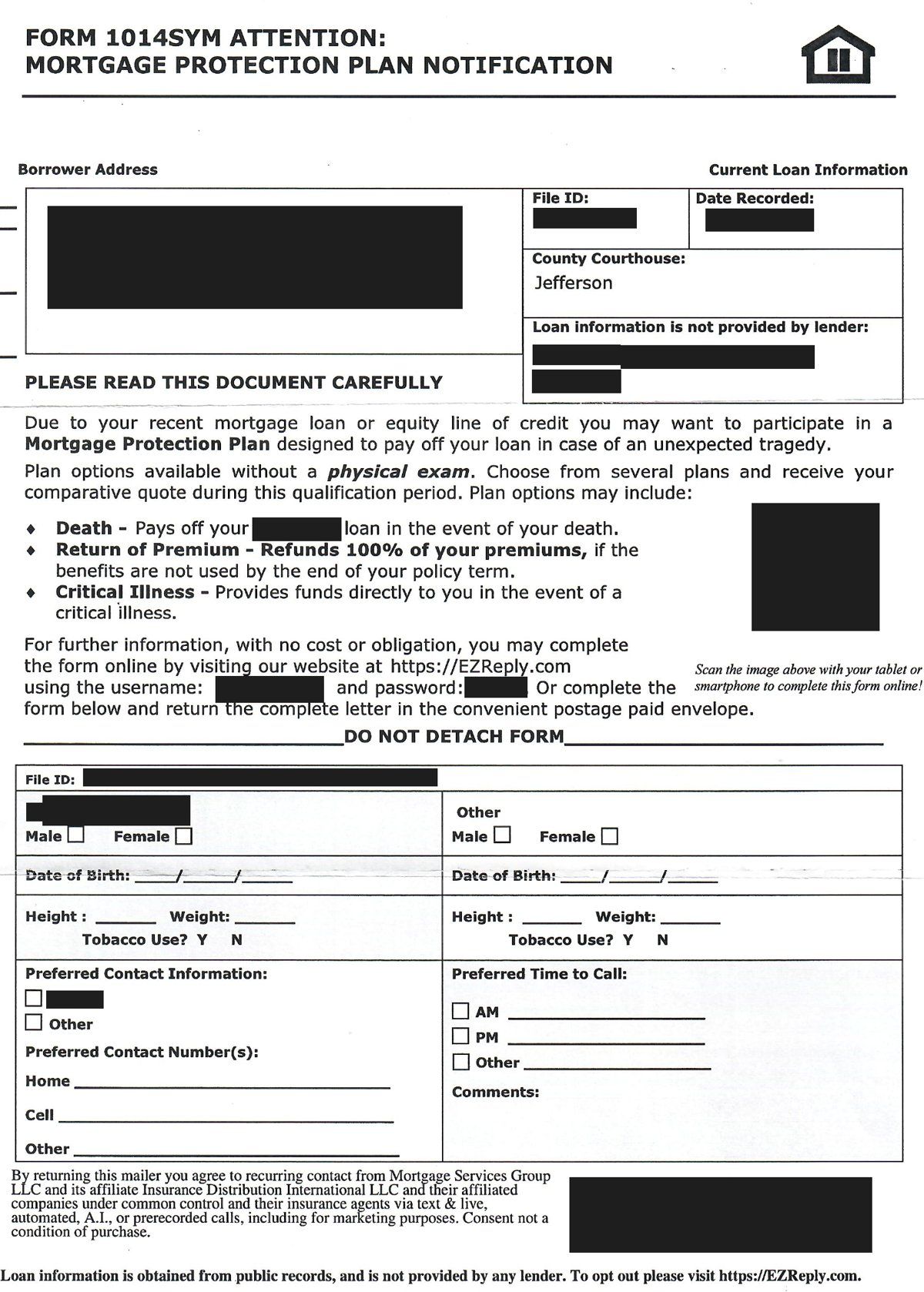
A "form number" and "file ID" make it look official. Read the fine print: loan information is not provided by any lenderMortgage protection insurance reply form advertising a no physical exam mortgage life policyjpg]
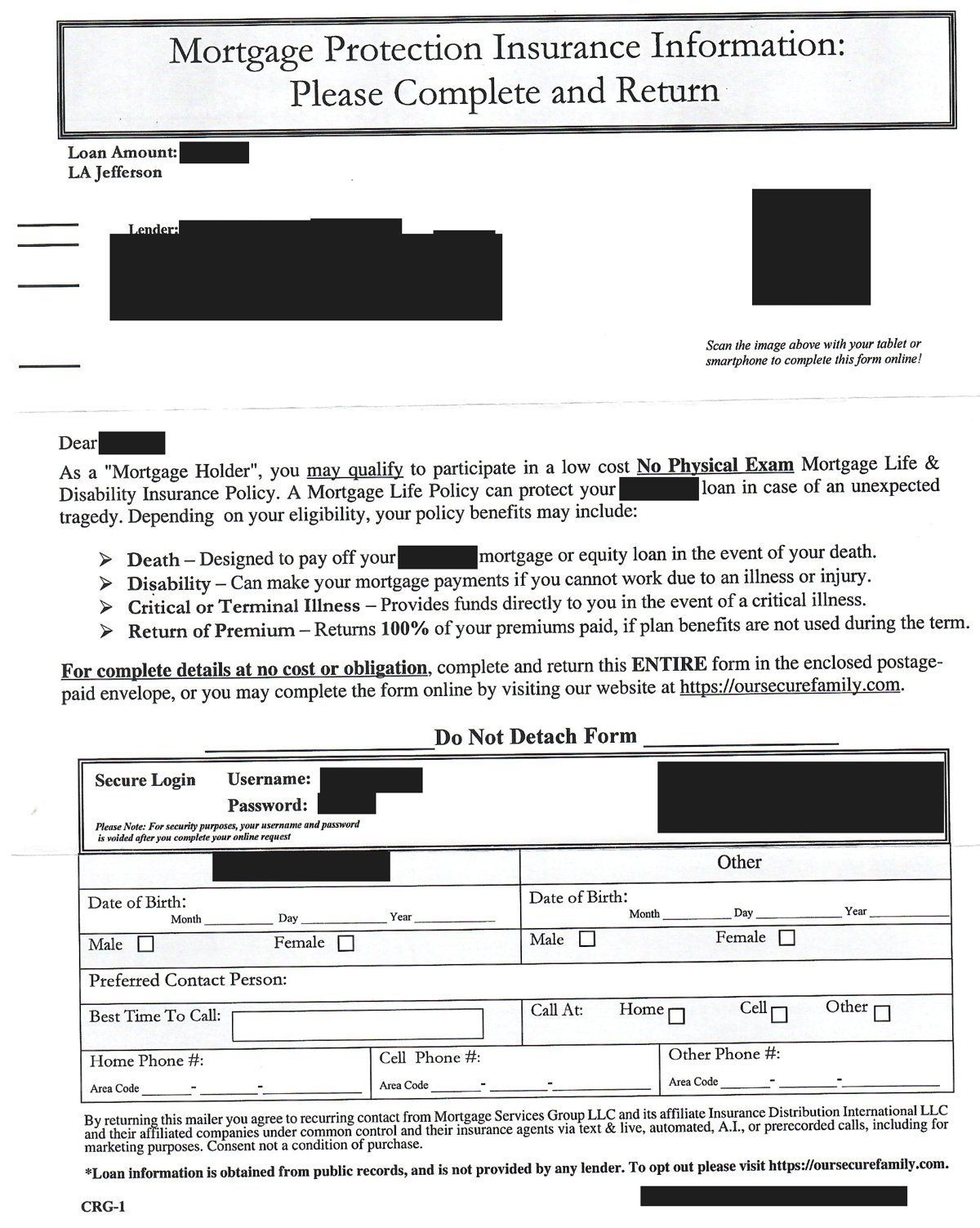
"No physical exam" sounds easy. It also usually means you're priced like the least healthy applicant.


Notice the patterns:


  • "Important notice," "immediate response needed," and deadlines for something you never signed up for
  • Your lender's name printed in bold so it reads like the letter came from them
  • Official sounding numbers: a "Mortgage ID," a "File ID," a form number, even an "authentication phrase." Some mailers go as far as a fake insurance ID card.
  • Fine print, usually tiny and near the bottom, saying the company is not affiliated with your lender and got your information from public records


None of this is required. If you ever want to know whether a letter is really from your lender, call the number on your closing documents or your monthly statement. Don't use the number printed on the mailer.


The Pricing Problem

Even if you see through the scare tactics, the coverage itself can cost you. Many of these offers are issued with no medical exam. That sounds convenient, but it usually means the price is built for the least healthy person who could apply, not for you. If you're in reasonable health, a policy written through a licensed agent who looks at your actual situation will often cost less for the same coverage or more.


What Mortgage Protection Insurance Really Is

Setting the junk mail aside, mortgage protection insurance is a real product. It's just narrower than most people think.


Traditional mortgage protection insurance, sometimes called mortgage life insurance, pays your lender. If you pass away, the loan balance gets paid off. Your family keeps the house, but the money never goes to them. With a regular term or whole life policy, the death benefit goes to the people you name, and they decide how to use it: the mortgage, the light bill, daycare, college, whatever comes first.


The name gets used loosely, too. Some policies marketed as "mortgage protection" are really term life policies with your family as the beneficiary. That's exactly why this should be a decision you make on purpose with someone you can sit across from, not something you mail back in a panic because a letter made it sound mandatory.


The Real Conversation Is Bigger Than the Mortgage

I'll be honest about something. This isn't a conversation I've pushed hard enough with my clients over the years, and that's a gap I want to close.


Buying a home rarely happens on its own. It often comes with getting married, having a baby, or planning for one. When that's your situation, the real need usually goes well past the house. It's replacing your income for your family, covering other debts, and protecting your kids' future. The mortgage balance is one piece of a bigger picture.


Life insurance serves a major purpose, and once you own a home, sitting down with a licensed agent is one of the most important things you can do. The best time to start that conversation is before you close. Coverage is a real monthly cost, and it belongs in your homebuying budget right alongside taxes, homeowners insurance and flood insurance. Plan for it up front instead of bolting it on later because a scary letter showed up.


A Real Person to Talk To

If you haven't had this conversation, or you got one of these letters and aren't sure what to make of it, I'd point you to Marcel Lashover, RFC, at One Stop Financial Group in Metairie. He's a licensed life insurance professional, not a mail house, and he'll look at what you actually need, whether that's coverage tied to your mortgage or something broader for your family.


One Stop Financial Group offers a free mortgage protection review that looks at your current coverage, whether it's enough, and where the gaps are. Learn more at onestopfinancialgroup.net/mortgage-protection or call (504) 300-8207.


If you're planning a purchase, call me at (504) 214-8402. We'll work on the mortgage side together, and I'll connect you with Marcel before you're at the closing table so the cost is part of your plan from day one.


Bernard Guste, Loan Officer, Nexa Lending

borrowlouisiana.com



Bernard Guste, Mortgage Loan Originator, NMLS #79676. NEXA Mortgage, LLC NMLS #1660690. Equal Housing Lender. This is general information, not insurance or financial advice. Life insurance products and recommendations should be discussed with a licensed insurance professional based on your individual needs.

Recent Posts

Louisiana couple reviewing their mortgage statement with a calculator, planning a mortgage recast
By Bernard G • September 5, 2026
A mortgage recast lowers your monthly payment for a small fee without refinancing or giving up your rate. See how it works, what it costs, and why to plan ahead.
By Bernard G • September 1, 2026
A hard pull is necessary when applying for a mortgage. Let’s start there. There are exceptions for everything. We can use a soft pull to provide some information but generally speaking a hard pull is necessary. It's one of the first questions almost every new client asks. Understandable, considering the barrage of information from services like Credit Karma that has conditioned the public to believe checking your credit is inherently risky if it’s a hard pull. It isn't, and for a mortgage specifically, the fear is almost entirely misplaced. Why Credit Scoring Treats a Mortgage Pull Differently FICO, the company behind the score used in most mortgage decisions, built specific rules into its formula because it recognizes that someone shopping for a mortgage is looking for one loan, not opening a stack of new debt. That's a meaningfully different signal than someone applying for several credit cards at once, which can suggest a person is trying to lean on credit to cover a gap in income. FICO's own scoring logic reflects that distinction directly. Two protections apply specifically to mortgage, auto, and student loan inquiries, as FICO itself explains : A grace period. The newest FICO score versions ignore rate-shopping inquiries entirely for the first 30 days. If you're actively shopping right now, those pulls simply aren't counted during that window. Multiple inquiries count as one. Multiple mortgage inquiries within a shopping window, 45 days under the newest FICO models, 14 days under older ones, get counted as a single inquiry, no matter how many lenders actually pulled your credit. Credit card inquiries don't get either of these protections. Every card application counts on its own. That's the real distinction worth understanding: the scoring models themselves treat rate-shopping for a loan as fundamentally different from opening new credit. Here's the part that surprises even people who think they understand credit: all three credit bureaus, TransUnion, Experian, and Equifax, actually run FICO's scoring model. TransUnion, Experian, and Equifax aren't competing scoring systems, they're the companies that hold your credit data, and FICO is the formula they license to turn that data into a number. That's why a real tri-merge credit report shows three different scores for the same person on the same day, each one labeled FICO, just under a different branded version: Equifax runs Beacon 5.0, Experian runs FICO-II, and TransUnion runs FICO Classic 04. Different bureau, different generation of the same underlying formula, which is why the numbers vary even though every one of them is a genuine FICO score. That matters here because the 45-day rate-shopping window isn't something one bureau offers and another doesn't. It's built into the FICO formula itself, which means it applies the same way across all three bureaus. There is also VantageScore, a separate scoring model TransUnion, Experian, and Equifax built jointly as an alternative to FICO. It has its own version of this same protection, a 14-day window for counting multiple inquiries as one instead of FICO's 45, considering inquiries over 24 months instead of 12. The specifics differ, but the underlying idea holds across both major scoring systems: shopping for a loan gets treated differently than opening new credit. This model is just recently being allowed to be used for mortgage lending so stay tuned for more info! Even When It Does Register, the Impact Is Small and Temporary Even outside the protected window, FICO's own published guidance says a single inquiry typically costs less than 5 points. For most borrowers, that's not enough to move a lending decision at all. And the effect doesn't linger, the drag on your score fades within months, and while inquiries stay visible on your credit report for two years, they only factor into your FICO score calculation for 12 months. Given that window, there's very little reason to need a second credit pull once the first one starts the clock. The real key is getting your shopping done inside that timeframe, and making sure whoever pulls your credit actually reviews the report and works through anything on it that needs to be addressed while that window is still open. That includes getting a real preapproval, not just a quick number, one where an underwriter has actually reviewed your income and assets and confirmed everything is in order, so a second pull outside the window never becomes necessary in the first place. A Small Detail Worth Knowing When a lender pulls your credit, they can see inquiries and what lenders made them. Guidelines require lenders to list all inquiries made in the last 90 days and confirm none of them have turned into new debt. It is normal to be asked about this during your application. You are simply confirming those earlier pulls were rate shopping. The lender’s main goal here to very you have not accepted new credit so they have a clear credit profile. One detail worth knowing. The first lender to pull your credit won't see any pulls that come after theirs, only the ones already on file. If the lender who ends up closing your loan happens to be the last one to pull your credit, they'll be the one asking you to explain all the earlier inquiries. The time-saving move: Get your credit pulled by your favorite lender first WHICH should always be me! 😊 Why Pulling Credit Sooner Is Actually the Safer Move Pulling your credit early isn't the risk. Not knowing what's actually on your report is the bigger one. It's not unusual to find a delinquency, a collection account, or even an account that isn't yours at all sitting on someone's credit report without them realizing it. You'd be surprised how often this happens, sometimes from good intentions gone sideways, like a parent adding a child as an authorized user on a card years ago, an account the child never knew was there and that's now quietly affecting their credit. Finding that out early, while there's still time to address it, matters far more than avoiding a pull that barely moves your score in the first place. The Bottom Line Letting your loan officer pull your credit isn't the risky step. Waiting because you're afraid it will hurt your score is often the more costly move, since it delays finding out where you actually stand. If you've been putting off applying because of this exact question, it's a good time to stop. Call me at (504) 214-8402 and let's see what your real numbers look like. Bernard Guste, Mortgage Loan Originator, NMLS #79676. Equal Housing Lender. Credit scoring impacts vary by scoring model and individual credit history. This is general information, not a guarantee of a specific score outcome.
By Bernard G • August 26, 2026
Rural Development Loans Offer Zero Down. Did You Know You Might Qualify for One Less Than 10 Minutes from Downtown New Orleans?